Tax on Agricultural Income in Punjab
Agricultural income is an exempt income from tax under section 41 of the Income Tax Ordinance, 2001. Such exemption from tax under ITO 2001 ( section 41 & section 111(1)(d) ), is available only when agriculture income is charged to tax under provincial law.
THE PUNJAB AGRICULTURAL INCOME TAX ACT 1997
In Punjab, the taxation of agriculture income is administered under the provincial law of “The Punjab Agricultural Income Tax Act 1997“. Under such Act, Agriculture Income is taxed by any of the following two methods;
AREA or LAND BASED:Agriculture income taxed based on acres.
INCOME BASED:Agriculture income tax based on Income computed under clause 4 of the Act (as per schedule 2).
Tax Payable Basis: Whichever is higher.
The said ACT, also allows the taxpayers to pay such agriculture income tax through their agriculture income declared in ‘Income Tax Return’ (ITR) (as per schedule 2 –Income based).
Tax on the basis of income tax return ( 3B )
Notwithstanding the provisions of section 3, where any person has declared agricultural income for any assessment year in the return filed under the Income Tax Ordinance, 2001, the person shall pay the tax on such income at the rate specified in the Second Schedule.”
It is important here to mention that exemption was given by provincial revenue authority in relation to provincial tax payable on agriculture income as per Second Schedule (Income Based) in a meeting held on October 15, 2016. So, only Area / Land based agriculture income tax is applicable since then in Punjab.
Exemptions from Provincial Agriculture Income Tax
If area is below than 12.5 acres then area wise tax is also exempt. Agriculture Income is exempt up to400,000, as per the Act “The Punjab Agricultural Income Tax Act 1997”.
“Agricultural Income” Definition under Income Tax Ordinance, 2001
(a) any rent or revenue derived by a person from land which is situated in Pakistan and is used for agricultural purposes;
(b) any income derived by a person from land situated in Pakistan from —
(i) agriculture;
(ii) the performance by a cultivator or receiver of rent-in-kind of any process ordinarily employed by such person to render the produce raised or received by the person fit to be taken to market; or
(iii) the sale by a cultivator or receiver of rent-in-kind of the produce raised or received by such person, in respect of which no process has been performed other than a process of the nature described in sub-clause (ii); or
(c) any income derived by a person from —
(i) any building owned and occupied by the receiver of the rent or revenue of any land described in clause (a) or (b);
(ii) any building occupied by the cultivator, or the receiver of rent-in-kind, of any land in respect of which, or the produce of which, any operation specified in sub-clauses (ii) or (iii) of clause (b) is carried on,
but only where the building is on, or in the immediate vicinity of the land and is a building which the receiver of the rent or revenue, or the cultivator, or the receiver of the rent-in-kind by reason of the person’s connection with the land, requires as a dwelling-house, a store-house, or other out-building.

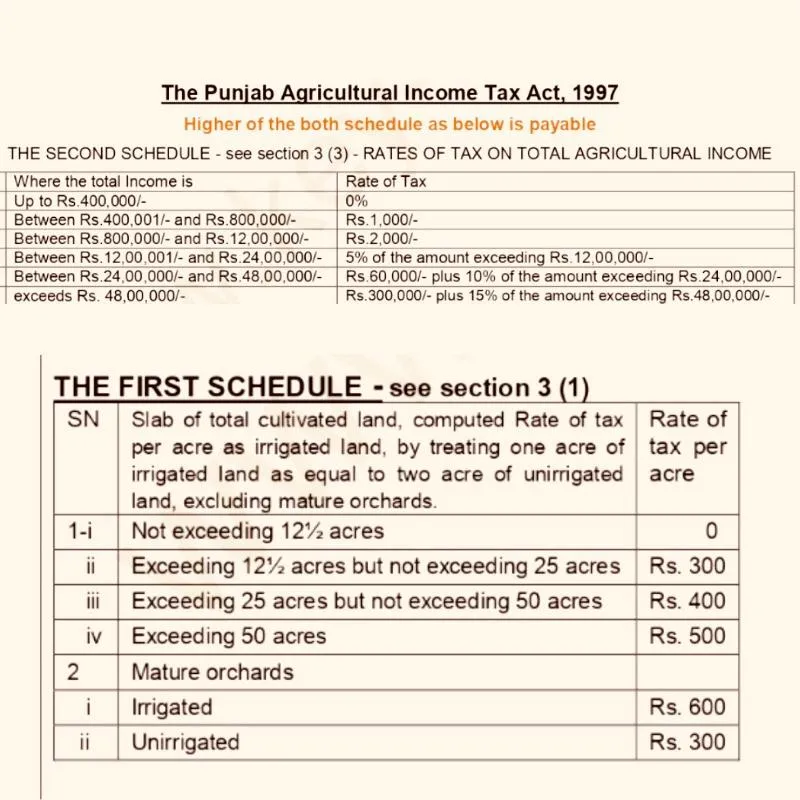
Rate of tax on total agricultural income as per acre; THE FIRST SCHEDULE [SEE SECTION 3(1)]
Land-based or area based tax is assessed on the basis of the Cultivated Land Area. The rate of tax is based on the number of Acre as irrigated land. If the cultivated land is unirrigated then one acre of irrigated land is equal to two-acre of unirrigated land. Tax on unirrigated land is half of the irrigated land.
| S.No | Land / Area | Rate of Tax |
|---|---|---|
| 1 | 12.5 acres land ownership | No Tax |
| 2 | 12.5 acres to 25 acres | Rs.300 per acre |
| 3 | 26 acres to 50 acres | Rs.400 per acre |
| 4 | 50 acres or more | Rs.500 per acre |
| (2) Mature orchards | ||
| Irrigated | Rs 600 per acre | |
| Unirrigated | Rs 300 per acre |
Note: Slab of total cultivated land, computed Rate of tax per acre as irrigated land, by treating one acre of irrigated land as equal to two acre of unirrigated land, excluding mature orchards.
Mature Orchard” means orchard of the age of seven years or more in the case of mango orchard and of the age of five years or more in the case of other orchards;
RATES OF TAX ON TOTAL AGRICULTURAL INCOME – THE SECOND SCHEDULE [SEE SECTION 3(3)]
Under The Punjab Agriculture Income Tax Act 1997, Agriculture Income consists of any rent, revenue or income derived from land which is situated in Punjab and is used for agricultural purposes as reduced by permissible allowances and deductions. Taxable agriculture income of a person for the tax year will be calculated as below:
| S.NO | Agriculture Income Slab | Tax Rate (%) |
|---|---|---|
| 1 | If total income does not exceed Rs.400,000/= | 0% |
| 2 | If total income is more than Rs.400,000 but does not exceed Rs.800,000/= | Rs.1,000 |
| 3 | If total income is more than Rs.800,000 but does not exceed Rs.1,200,000/= | Rs.2,000 |
| If total income is more than Rs.1,200,000 but does not exceed Rs.2,400,000/= | 5% of the amount exceeding Rs 1,200,000 | |
| If total income is more than Rs.2,400,000 but does not exceed Rs.4,800,000/= | Rs 60,000 plus 10% of the amount exceeding Rs 2,400,000 | |
| 4 | If total income is more than Rs.4,800,000/= | Rs 300,000 plus 15% of the amount exceeding Rs 4,800,000 |
Authority to Collection of Tax
Tax on Agriculture Income is assessed and collected by the Collector of district. Who is Appointed under The Punjab Land Revenue Act 1967. In case a person is holding land in more than one patwar circle, the owner shall file a statement regarding the location of his land in the Punjab.
Allowances and Deductionsallowed against Agriculture Income:
(a) any expenditure on account of labour for–
(i) tilling the land;
(ii) sowing the seed;
(iii) ploughing/planting;
(iv) tending/pruning;
(v) rendering the produce fit to be taken to market;
(vi) any other agricultural operation;
(b) any expenditure incurred on purchase of–
(i) seed;
(ii) fertilizers and pesticides;
(c) any expenditure incurred on–
(i) hiring animals, tractors, agricultural machinery and implements used for earning agricultural income;
(ii) repair and maintenance of water-courses;
(d) any expenditure incurred on–
(i) harvesting of agricultural produce;
(ii) marketing of the agricultural produce;
(e) any sum paid on account of–
(i) ushr;
(ii) local cess and other cesses;
(iii) water-rate (Abiana);
(iv) electricity bills in respect of tubewells and lift pumps used for agriculture;
(v) fuel charges in respect of tubewells and lift pumps uses for agriculture;
(vi) rent of land used for agriculture;
(vii) obtaining of agricultural loans;
(viii) mark-up on agricultural loans;
(f) in respect of depreciation of such buildings, machinery and plant being the property of the assessee used for the purpose of earning agricultural income, allowance at the rate of 15 percent of the written down value; and
(g) any other expenditure not being in the nature of capital expenditure or personal expenses of the assessee laid out or expended wholly and exclusively for the purposes of agriculture.

Agriculture Income | Agriculture Income Tax | FBR | Federal Board of Revenue |
LATEST POSTS
- New Taxes on E-commerce Transactions in Pakistan
 New Taxes on E-commerce Transactions in Pakistan: In the recent budget (Finance Act 2025) Government of Pakistan has taken some significant steps towards the taxation of local ecommerce industry of Pakistan. The new amendments in the Income tax Ordinance 2001 and Sales Tax Act 1990 will affect all those ecommerce businesses operating through online platforms, websites, or courier based Cash on Delivery (COD) Model. Below are the significant highlights of amendments in tax laws of Pakistan which are necessary for your understanding: Enhanced Definition of “Online Market Place” Through Finance Act 2025, section 2(38B) of income Tax Ordinance 2001 amended and definition of “Online Market Place” has been broadened. It now also includes: These will help buying and selling between multiple parties, whether the platform owns the goods/services or not. New Taxes on E-commerce Transactions in Pakistan for Digitally Ordered Goods/Services Through Finance Act 2025, a new section, 6A in the Income Tax Ordinance, introduces a tax on payments received for digitally ordered goods/services through local platforms (including websites). Applies To:This section applies to all persons receiving payments for goods/services delivered from within Pakistan via online platforms. Excludes:It does not include export proceeds received in Pakistan which are already taxed under sections 154 and 154A. Tax Collection by Payment Intermediaries and & Couriers Under amendment in section 153(2A) of Income Tax Ordinance 2001 through Finance Act 2025: This applies to all payments made for digitally ordered goods and services via local platforms, including websites. Rate of Income tax to be deducted from a payment for digitally ordered goods/services Two different tax rates has been introduced for payments to ecommerce sellers against digitally ordered goods, complete description is here: Sales Tax Collection Responsibility As per Sales Tax Act 1990, the responsibility to collect and pay sales tax on digitally ordered goods is explained here: Rates of Sales Tax on Payments against Digitally ordered goods The applicable rates of sales tax to be deducted are given in the Eleventh Schedule of the Sales Tax Act 1990. The sales tax withheld by the payment intermediary or the courier company will be final discharge of tax liability against the digitally ordered goods by the: AS per the eleventh schedule of Sales Tax Act 1990 the rate of sales tax to withhold to withhold by the payment intermediary / Courier Company will be at the rate of 2% of gross value of supplies. Mandatory NTN & Sales Tax Registration To promote documentation and transparency: Unregistered sellers will not be allowed to operate on their platforms.
 - FBR Extends Sales Tax & FED Return Filing Deadline for June 2025FBR Extends Sales Tax & FED Return Filing Deadline for June 2025 – The Federal Board of Revenue (FBR) has officially extended the last date for filing sales tax and Federal excise Duty Return for the period of June 2025. FBR Extends Sales Tax & FED Return Filing Deadline for June 2025 New due date to file the sales tax and FED return is now 4th August 2025 which was due on 18.07.2025. This extension has been granted to to facilitate the taxpayers that they must ensure their monthly compliance delaying due to technical issues facing on FBR Iris Portal. FBR issued a notification in this regard on his official website and communicated the new extended deadline for filing sales tax return.
- Budget 2025 Update: FBR Broadens Definition of Online MarketplaceBudget 2025 Update: FBR Broadens Definition of Online Marketplace: In the recent federal budget 2025-26, the Federal Board of Revenue (FBR) has redefined “Online Market Place” for the purpose of regularizing and taxing the fast growing digital economy of Pakistan. One of the important update in the Income Tax Ordinance, 2001, is the redefinition of the term “online marketplace.” The change in definition will bring a massive change to a wide range of digital platforms and sellers, remodeling how e-commerce competitors deals with the tax system in Pakistan. New Definition of “Online Marketplace” Section 2(38B): “online marketplace” means an information technology platform run by e-commerce entity over an electronic network that acts as a facilitator in transactions that occur between a buyer and a seller and includes “online interfaces” that facilitate, for a fee, the direct interaction between multiple buyers and multiple sellers via digital orders for supply of goods and services, with or without the platform taking economic ownership of the goods or providing or rendering the services that are being sold.“
- FBR Opens Tax Return Filing Tax Year 2025 – Great Submit NowFBR Opens Tax Return Filing Tax Year 2025 – Recently Federal Board of Revenue (FBR) has formally issued the tax return form for Tax Year 2025. It is a great news and now taxpayers can submit their annual income tax returns by using the updated form via the FBR Iris Portal. It is highly recommended to you to file your annual income tax returns well before the last date to avoid tax notices and penalties thereafter. What is Deadline Line for Filing Tax Return? For Filing Tax Return for Tax Year 2025 last date to file tax return for Salaried class, individuals and Partnership businesses is 30th September 2025. For Companies registered under the Companies act 2017 the deadline is 31st December 2025. Who Should File the Income Tax Return? You should file your tax return if you fall in any of the following categories: Benefits of Filing Your Tax Return Following are the benefits of filing tax return in Pakistan. Need Help with Filing your Return? If you need any help in filing your tax return then you may contact us. Contact: Global Tax Consultants, 00923334875413 Address: Office No UM-33, Zainab Tower, Model Town, Link Road, Lahore-Pakistan. https://globaltaxconsultants.pk
- FBR Biometric Verification Mandatory by 31st July 2025 – What Taxpayers Must Know?FBR Biometric Verification Mandatory by 31st July 2025 – What Taxpayers Must Know? – If you’re Sales tax registered taxpayers in Pakistan, the deadline is ahead: 31st July 2025 like you did your biometric verification last year in July. Under the provision of proviso to sub-rule (4) of rule 5 of the Sales Tax Rules, 2006, every individual, any member of an association of persons, and a director of a company are required to visit e-Sahulat Centre of NADRA during the month of July every year for biometric re-verification Why FBR Biometric Verification Mandatory by 31st July 2025? You must know that if no biometric verification, then no sales tax return filing. How to do Biometric Verification? You have to go to any NADRA e-Sahulat Centre with your original CNIC for biometric verification of sales tax.
- FBR Introduces Multi-Factor Login Authenticator for Sales Tax UsersFBR Multi-Factor Login Authenticator – To ensure privacy, increase of security and simplify access to the sales tax system the Federal Board of Revenue (FBR) through Pakistan Revenue Automation Limited (PRAL) has launched a Multi-Factor Login Authentication system for sales tax registered taxpayers. What are the key features of the new FBR Multi-Factor Login Authenticator? Following are the key features of the new system introduced by the FBR for logging FBR Iris Portal for those taxpayers who are also registered in sales tax with FBR.






TaxUrdu.com

