Every cash transaction for sale or purchase of housing units worth more than Rs. 2 million must be reported under Anti Money Laundering (AML) / Counter Terrorism Financing (CFT). To comply with the requirements of Financial Action Task Force (FATF). The Federal Board of Revenue (FBR) instructed on Monday. Real estate agents (REAs) have to comply with the requirements of the AML and Counter Financing of Terrorism (CFT) era.
The FBR said that a Currency Transaction Report (CTR) needs to be submitted. When a developer receives cash or bearer instruments of Rs 2 million or more for the sale of real estate. The developer sells directly to the buyer and receives a direct cash payment. Similarly, a developer pays Rs 2 million in cash and more to buy real estate e.g. Property developers or builders pay for the purchase of development property.
Similarly, a broker receives or pays Rs 2 million or more to use later in the purchase of immovable property. A broker is a buyer’s agent who collects cash for later deposits and / or settlement payments (receipts or the resulting use may meet the threshold of CTR). However, if all financial transactions are by wire transfer, the real estate agent will not be required to file a CTR. If the REA pays the sales staff in cash, or to a supplier, or to purchase an asset such as a motor vehicle, it will not be subject to filing a CTR as no transaction of immovable property.
The FBR said the reason is that the REAs are subject to FATF standards and the AML / CFT measures are aimed at raising funds from criminal activities due to the large amount of involvement of the real estate sector. Real estate can also involve in financing terrorism because terrorist groups can buy or sell immovable property. There is a definition of REA under both AMLA and AML / CFT regulations, as follows:

Anti money laundering Act, Section 2. Specifications (xii) (a)
(a) real estate agents, including builders and real estate developers, when performing the prescribed activities in the prescribed circumstances and manner;
-FBR AML/CFT Regulations for DNFBPs in Section 2.Definitions (n):
(n) “Real Estate Agent” includes builders, real estate developers and property brokers and dealers when execute a purchase and sale of a real property, participate in a real estate transaction capacity and are exercising professional transnational activity for undertaking real property transfer;

LATEST POSTS
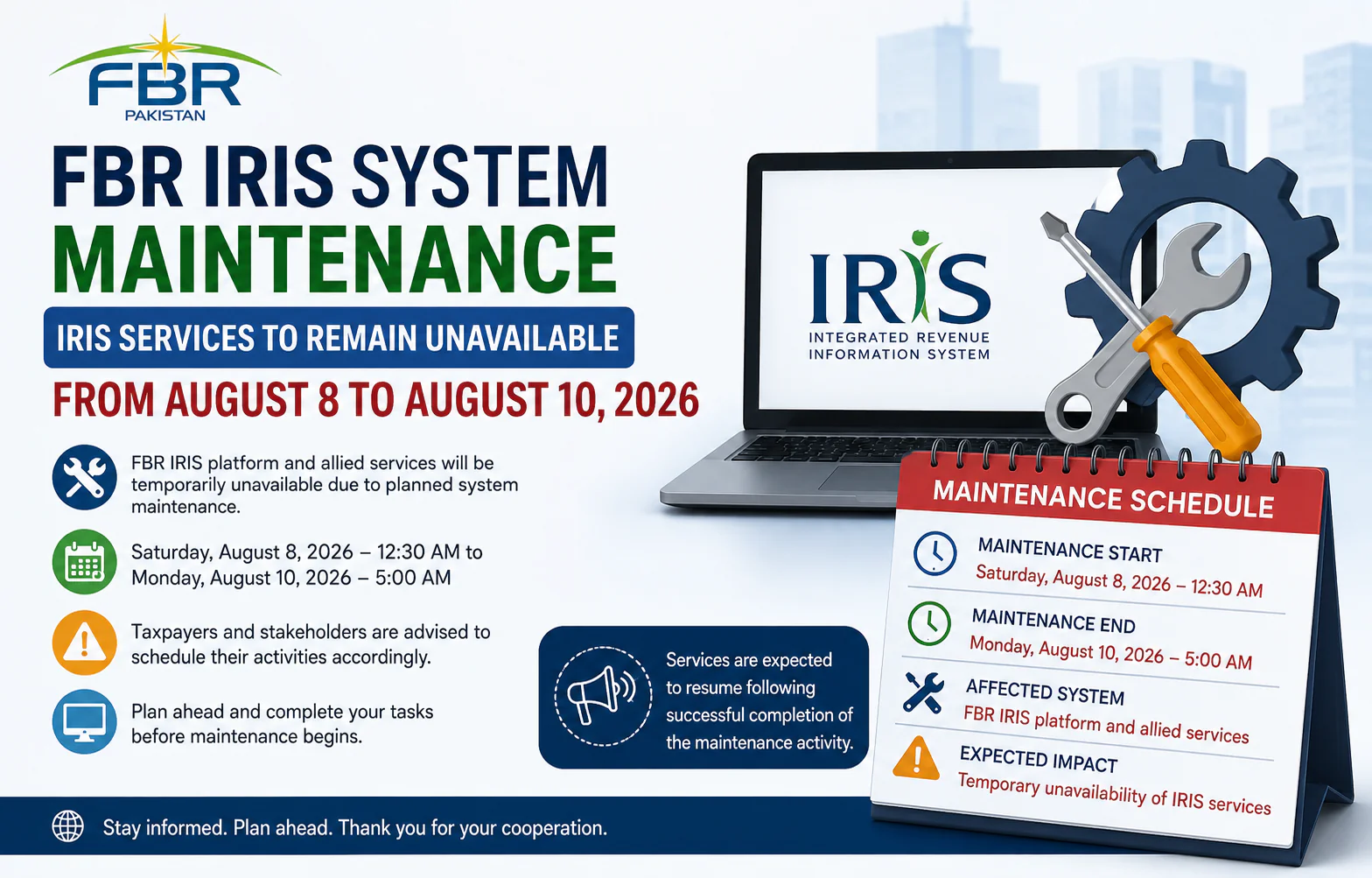
- FBR IRIS System Maintenance: Services to Remain Unavailable from August 8 to August 10, 2026
 FBR IRIS Maintenance Schedule August 2026: IRIS Services Temporarily Unavailable The Federal Board of Revenue (FBR) today announced on his website that a planned system maintenance activity for its IRIS platform and allied services scheduled to begin at 12:30 AM on Saturday, August 8, 2026, and expected to continue until 5:00 AM on Monday, August 10, 2026. FBR IRIS Maintenance Schedule The announced maintenance window is as follows: Particular Details Maintenance Start Saturday, August 8, 2026 – 12:30 AM Maintenance End Monday, August 10, 2026 – 5:00 AM Affected System FBR IRIS platform and allied services Expected Impact Temporary unavailability of IRIS services In notice FBR has advised taxpayers and stakeholders to schedule their activities accordingly. IRIS and Allied Services Will Be Temporarily Unavailable During the maintenance period, the IRIS platform and its allied services will remain temporarily unavailable. All users may not be able to access the system. What Should Taxpayers Do Now? Taxpayers, businesses and tax practitioners should take the maintenance schedule into account when planning their online tax activities. Users of FBR IRIS system may reschedule their activities and can focus on preparation of tax working papers and schedule submission of tax returns and related activities after IRIS will available on Monday morning. When Will FBR IRIS Services Resume? According to the official announcement, the scheduled maintenance expected to end at 5:00 AM on Monday, August 10, 2026. Services expected to resume following successful completion of the maintenance activity. TAGS How to Check ATL Status with FBR | How to Download Taxpayer Registration Certificate FBR Online | Taxpayer Profile Inquiry Online FBR | How to Become an Active Tax Filer in Pakistan | FBR Iris Registration | How to File Income Tax Return in Pakistan | FBR Income Tax Return | FBR NTN Verification | FBR Taxpayer Registration | Active Taxpayer List (ATL) | FBR Tax Updates | Income Tax Return Filing | Pakistan Tax Return | FBR Online Services
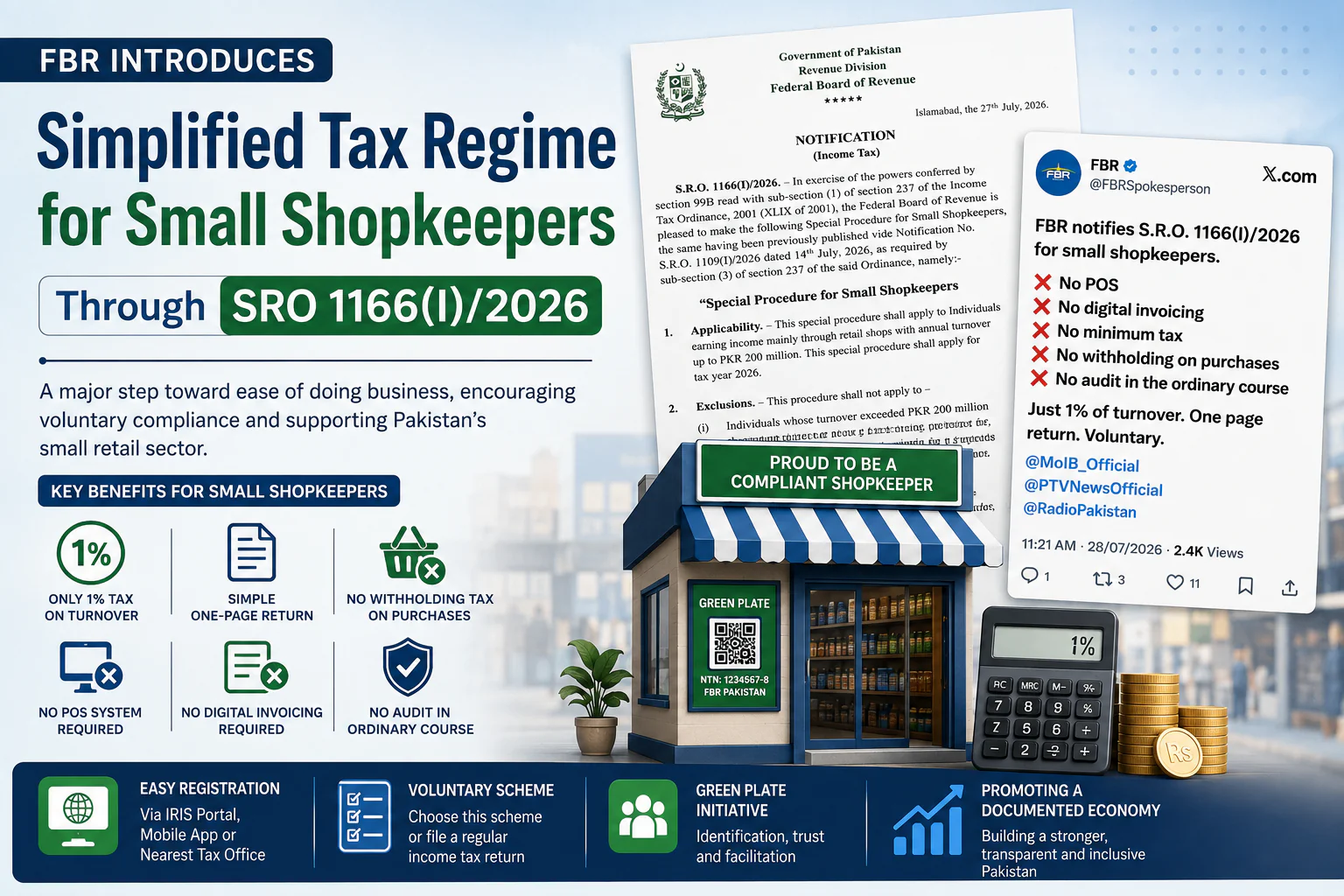
 - FBR Introduces Simplified Tax Regime for Small Shopkeepers Through SRO 1166(I)/2026FBR Launches Special Tax Scheme for Small Shopkeepers Under SRO 1166(I)/2026 A Major Step Toward Ease of Doing Business for Pakistan’s Small Retail Sector Small shopkeepers and retailers are the backbone of Pakistan’s economy. This sector from grocery stores and clothing outlets to electronics and household goods retailers, millions of small businesses creating employment opportunities and sharing in economic activity in the country. Small retailers always feel the tax system complex, difficult to comply with. In this regard, the Federal Board of Revenue (FBR) has recently introduced a new Special Procedure for Small Shopkeepers through SRO 1166(I)/2026. It will simplify tax compliance, increase in no of taxpayers, and business-friendly environment for small retailers across the country. What is SRO 1166(I)/2026? On July 27, 2026, the Federal Board of Revenue issued SRO 1166(I)/2026 under Section 99B read with Section 237 of the Income Tax Ordinance, 2001. The notification introduces a special tax procedure applicable to eligible small shopkeepers for Tax Year 2026. The main purpose of this scheme is to provide a simple and practical tax system that allows small retailers to fulfill their tax obligations. Who Can Benefit from This Scheme? The special procedure is designed for individual shopkeepers whose annual turnover does not exceed PKR 200 million. The scheme will target small retailers operating a single retail shop. Who Is Not Eligible? The special procedure does not apply to: It is a Completely Voluntary Scheme This is totally A voluntary scheme. Eligible shopkeepers are free to choose between: What is Tax Rate: Just 1% of Turnover Under this scheme, shopkeepers will pay tax at the rate of 1% of gross turnover. This will simplify tax calculations, adjustments, and assessments. Shopkeepers can now easily compute their tax liability based on their total annual turnover. No Need of POS and Digital Invoicing Requirements Under SRO 1166(I)/2026: No Withholding Tax Requirements Normally, are required to withhold taxes on specific purchases under tax law of Pakistan. But under this SRO there is no need to deduct income tax. No Minimum Tax Under Section 113 It also gives relief from the minimum tax provisions under section 113. Shopkeepers under this scheme will not be subject to: Minimum Tax Requirement Under FBR’s Special Procedure for Small Shopkeepers Under FBR SRO 1166(I)/2026, shopkeepers must pay a minimum tax of PKR 25,000 along with their income tax return, regardless of withholding taxes already deducted. The payable tax will be the higher of net tax liability after adjustments or PKR 25,000. Simplified Tax Return Filing For this purpose the FBR has introduced a simplified one-page tax return designed for shopkeepers participating in the scheme. The return will require basic information such as: Importantly, the form will be made available in Urdu and regional languages. Easy Registration Process Eligible shopkeepers have option to register themselves through: Reduced Audit Exposure According to the notification, shopkeepers opting into the scheme will generally not be subject to audit in the ordinary course of business. However, FBR can take action in limited circumstances, including: Introduction of the “Green Plate” Scheme has introduced Compliant Shopkeeper Plate, commonly referred to as the “Green Plate.” Shopkeepers under this scheme will receive a plate consisting: Shopkeeper will place Green Plate prominently outside the business premises. Moreover, tax officials normally will not enter shopkeepers businesses regarding tax matters when the shopkeeper has Green plate displayed. Frequently Asked Questions about SRO 1166 Tags How to Register for NTN in Pakistan | Complete Guide to FBR IRIS Portal | How to File Income Tax Return in Pakistan | Benefits of Becoming an Active Taxpayer | Difference Between Filer and Non-Filer | FBR POS Integration Explained | Digital Invoicing System in Pakistan
- New Taxes on E-commerce Transactions in PakistanNew Taxes on E-commerce Transactions in Pakistan: In the recent budget (Finance Act 2025) Government of Pakistan has taken some significant steps towards the taxation of local ecommerce industry of Pakistan. The new amendments in the Income tax Ordinance 2001 and Sales Tax Act 1990 will affect all those ecommerce businesses operating through online platforms, websites, or courier based Cash on Delivery (COD) Model. Below are the significant highlights of amendments in tax laws of Pakistan which are necessary for your understanding: Enhanced Definition of “Online Market Place” Through Finance Act 2025, section 2(38B) of income Tax Ordinance 2001 amended and definition of “Online Market Place” has been broadened. It now also includes: These will help buying and selling between multiple parties, whether the platform owns the goods/services or not. New Taxes on E-commerce Transactions in Pakistan for Digitally Ordered Goods/Services Through Finance Act 2025, a new section, 6A in the Income Tax Ordinance, introduces a tax on payments received for digitally ordered goods/services through local platforms (including websites). Applies To:This section applies to all persons receiving payments for goods/services delivered from within Pakistan via online platforms. Excludes:It does not include export proceeds received in Pakistan which are already taxed under sections 154 and 154A. Tax Collection by Payment Intermediaries and & Couriers Under amendment in section 153(2A) of Income Tax Ordinance 2001 through Finance Act 2025: This applies to all payments made for digitally ordered goods and services via local platforms, including websites. Rate of Income tax to be deducted from a payment for digitally ordered goods/services Two different tax rates has been introduced for payments to ecommerce sellers against digitally ordered goods, complete description is here: Sales Tax Collection Responsibility As per Sales Tax Act 1990, the responsibility to collect and pay sales tax on digitally ordered goods is explained here: Rates of Sales Tax on Payments against Digitally ordered goods The applicable rates of sales tax to be deducted are given in the Eleventh Schedule of the Sales Tax Act 1990. The sales tax withheld by the payment intermediary or the courier company will be final discharge of tax liability against the digitally ordered goods by the: AS per the eleventh schedule of Sales Tax Act 1990 the rate of sales tax to withhold to withhold by the payment intermediary / Courier Company will be at the rate of 2% of gross value of supplies. Mandatory NTN & Sales Tax Registration To promote documentation and transparency: Unregistered sellers will not be allowed to operate on their platforms.
- FBR Extends Sales Tax & FED Return Filing Deadline for June 2025FBR Extends Sales Tax & FED Return Filing Deadline for June 2025 – The Federal Board of Revenue (FBR) has officially extended the last date for filing sales tax and Federal excise Duty Return for the period of June 2025. FBR Extends Sales Tax & FED Return Filing Deadline for June 2025 New due date to file the sales tax and FED return is now 4th August 2025 which was due on 18.07.2025. This extension has been granted to to facilitate the taxpayers that they must ensure their monthly compliance delaying due to technical issues facing on FBR Iris Portal. FBR issued a notification in this regard on his official website and communicated the new extended deadline for filing sales tax return.
- FBR Opens Tax Return Filing Tax Year 2025 – Great Submit NowFBR Opens Tax Return Filing Tax Year 2025 – Recently Federal Board of Revenue (FBR) has formally issued the tax return form for Tax Year 2025. It is a great news and now taxpayers can submit their annual income tax returns by using the updated form via the FBR Iris Portal. It is highly recommended to you to file your annual income tax returns well before the last date to avoid tax notices and penalties thereafter. What is Deadline Line for Filing Tax Return? For Filing Tax Return for Tax Year 2025 last date to file tax return for Salaried class, individuals and Partnership businesses is 30th September 2025. For Companies registered under the Companies act 2017 the deadline is 31st December 2025. Who Should File the Income Tax Return? You should file your tax return if you fall in any of the following categories: Benefits of Filing Your Tax Return Following are the benefits of filing tax return in Pakistan. Need Help with Filing your Return? If you need any help in filing your tax return then you may contact us. Contact: Global Tax Consultants, 00923334875413 Address: Office No UM-33, Zainab Tower, Model Town, Link Road, Lahore-Pakistan. https://globaltaxconsultants.pk
- FBR Biometric Verification Mandatory by 31st July 2025 – What Taxpayers Must Know?FBR Biometric Verification Mandatory by 31st July 2025 – What Taxpayers Must Know? – If you’re Sales tax registered taxpayers in Pakistan, the deadline is ahead: 31st July 2025 like you did your biometric verification last year in July. Under the provision of proviso to sub-rule (4) of rule 5 of the Sales Tax Rules, 2006, every individual, any member of an association of persons, and a director of a company are required to visit e-Sahulat Centre of NADRA during the month of July every year for biometric re-verification Why FBR Biometric Verification Mandatory by 31st July 2025? You must know that if no biometric verification, then no sales tax return filing. How to do Biometric Verification? You have to go to any NADRA e-Sahulat Centre with your original CNIC for biometric verification of sales tax.


PREVIOUS POSTS
- August 2026(1)
- July 2026(1)
- June 2026(5)
- July 2025(10)
- November 2024(1)
- May 2024(1)
- April 2024(4)
- March 2024(5)
- February 2024(2)
- January 2024(1)
- December 2023(6)
- November 2023(4)
- October 2023(11)
- September 2023(12)
- August 2023(16)
- July 2023(21)
- June 2023(40)
- May 2023(33)
- April 2023(17)
- March 2023(26)
- February 2023(55)
- January 2023(49)
- December 2022(24)
- November 2022(29)
- October 2022(21)
- September 2022(31)
- August 2022(33)
- July 2022(43)
- June 2022(38)
- May 2022(34)
- April 2022(23)
- March 2022(23)
- February 2022(26)
- January 2022(49)
- December 2021(38)
- November 2021(57)
- October 2021(48)
- September 2021(44)
- August 2021(55)
- July 2021(33)
- June 2021(46)
- May 2021(24)
- April 2021(25)
- March 2021(40)
- February 2021(30)
- January 2021(49)
- December 2020(36)
- November 2020(40)
- October 2020(16)
- September 2020(14)
- August 2020(11)
- July 2020(9)